How to Clean Up Water Damage in Your Basement (Before It Gets Worse)
How to Clean Up Basement Water Damage in Kitchener-Waterloo (Before It Gets Worse)
Water in your basement is one of those situations where the first hour matters more than most people realize. Whether it came in through a window well during a storm, backed up through a floor drain, or seeped through the foundation wall after a heavy Ontario rainfall, the clock starts the moment it appears. The visible water is the easy part. It is the moisture that stays behind in your walls, subfloor, and air that causes mould to grow and structural damage to compound.
This guide covers exactly what to do, in what order, and what equipment does the heavy lifting. The process described here is what restoration professionals in the space we work with follow on jobs where insurance adjusters are watching the work closely.
Step 1: Do Not Touch Anything Until You Check the Power
Before you grab a mop or a shop vac, go to your electrical panel and turn off the breaker to the basement. Water and electricity are a serious combination, and standing water near outlets, panel boxes, or appliances creates a real hazard. If the water has reached the level of any electrical device or outlet, do not enter the space at all until a licensed electrician confirms it is safe.
Furthermore, check where the water is coming from before you start removing it. If the source is still active, such as a broken pipe, a sump pump that has failed, or an ongoing storm drain backup, stopping the source comes before any drying effort. Removing water while more is coming in is a losing equation.
Step 2: Remove the Standing Water First
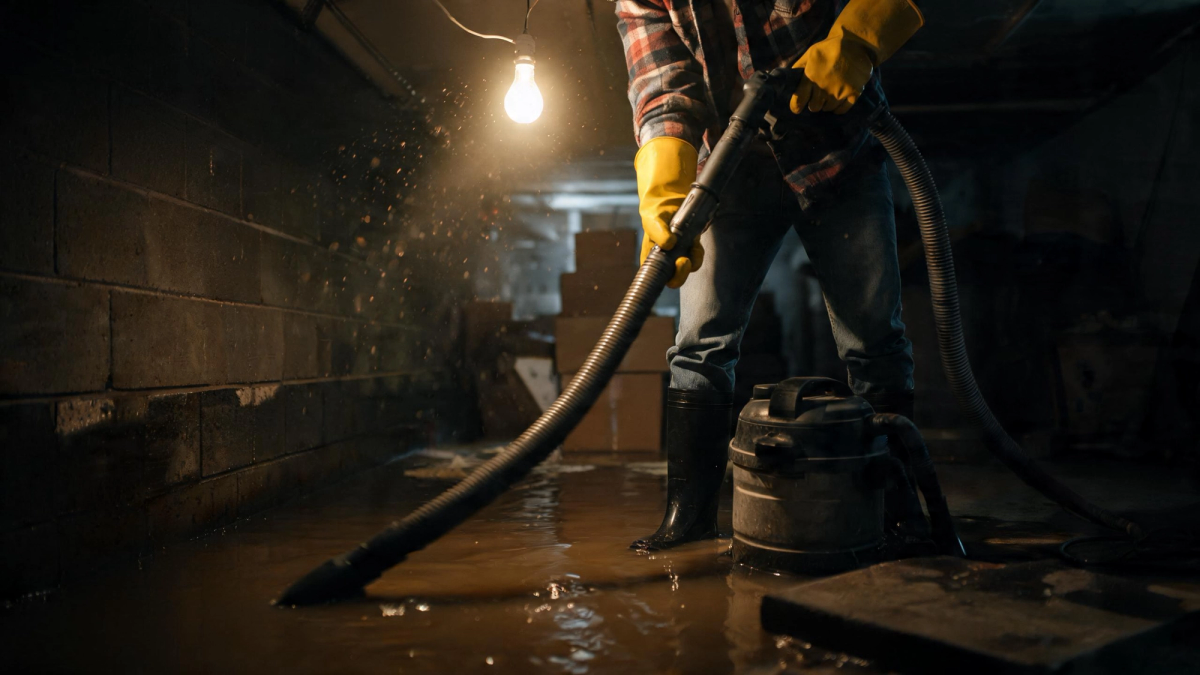
Once it is safe to enter, your priority is getting the standing water out. For most basement flooding situations, a wet-dry vacuum handles smaller volumes well and gives you precise control around furniture and finished areas. For larger volumes covering a significant portion of the floor, a submersible pump moves water faster and lets you run a hose directly to a floor drain or exterior.
Professionals in the space we work with generally use a combination of both. The pump clears the bulk of the water, and the wet-dry vac handles the edges, corners, and areas around walls where water pools and sits.
Do not use a regular household vacuum. The motor is not sealed for water and you will destroy the unit.
Step 3: Pull Up What Cannot Be Saved
Wet carpet holds moisture like a sponge. Drywall that has been submerged past the paper face is compromised. Baseboards trap water behind them. The longer these materials stay wet against a wall or floor, the higher the chance of mould growth behind them, which is significantly more expensive to deal with than replacing the materials themselves.
Cut and remove wet drywall to at least 12 inches above the water line. Pull carpet and underpad. Remove baseboards if the water reached them. This step feels aggressive, but restoration professionals in the space we work with are consistent on one point: conservative removal of damaged material saves money in the long run.
Step 4: Run the Drying Equipment
This is where most homeowners underestimate the job. The floor may look dry within a day or two. The structure behind it is not. Concrete absorbs water. Wall cavities trap humidity. Without active drying equipment running continuously, moisture lingers for weeks and creates the exact conditions mould needs.
The three pieces of equipment that do this job properly are:
An air mover directs high-velocity airflow across wet surfaces to accelerate evaporation. You typically position one unit every 50 to 75 square feet of affected area, aimed low along the baseboards and floor, and run them continuously. They are loud but they work.
A commercial dehumidifier pulls the evaporated moisture out of the air and collects it. A standard household dehumidifier from a big-box store is not the right tool here. Insurance adjusters who review restoration claims flag undersized dehumidifiers as a problem because they cannot keep up with the volume of moisture being displaced into the air during active drying. Commercial-grade units process significantly more air volume per hour and are what the job actually calls for.
A HEPA air scrubber filters the air in the space through multiple filtration stages, including an activated carbon layer for odour control and a HEPA filter that captures 99.97% of particulates at 0.3 microns. This matters because disturbed water damage, particularly when a floor drain backs up or the water has been sitting, introduces contaminants into the air that you do not want circulating through the rest of the house. The XPOWER X-2580 that A2B carries handles up to 550 CFM and is the same unit restoration companies use on jobs where the air quality standard is set by the insurance claim.
Run all three simultaneously. Drying typically takes 3 to 5 days depending on the extent of the damage, the materials involved, and the season. Ontario winters make drying harder because cold air holds less moisture and condensation on cold basement walls slows the process further.
Step 5: Check for Mould Before You Close It Back Up
Before you reinstall drywall, replace baseboards, or re-carpet, check every surface that was wet. Mould can begin to appear within 24 to 48 hours under the right conditions and is not always visible in its early stages. Look for discolouration, a musty smell that persists after drying, or any soft spots in wood framing.
If you find mould, do not encapsulate it behind new drywall. Remediation needs to happen first. Professionals in the space we work with use biocide sprays on framing before reconstruction and in some cases apply mould-resistant primer as an added layer of protection.
If you are unsure, a mould inspection is a few hundred dollars and gives you documentation that matters if you are filing an insurance claim.
Step 6: Address the Source So It Does Not Happen Again
Cleaning up after a basement flood is step one. Understanding why it happened is step two. Ontario gets significant rainfall in the spring and summer months, and KWC basements deal with a combination of factors: aging clay weeping tile, high water tables in certain areas, and storm drain systems that occasionally back up during heavy events.
Common root causes professionals in the space we work with encounter include a failed sump pump, cracked foundation walls, improper grading around the home that directs water toward the foundation, and blocked or undersized window wells. Most of these are addressable before the next weather event.
What A2B Carries for Basement Water Damage
A2B Rental Services rents restoration-grade equipment in Kitchener, Waterloo, and Cambridge. The equipment used on a real water damage job is not what is available at most hardware stores. Here is what we carry in this category:
XPOWER X-2580 4-Stage HEPA Mini Air Scrubber Commercial-grade air filtration with 550 CFM capacity and four stages including activated carbon and HEPA. Stackable and lightweight for basement access.
Commercial Dehumidifier High-capacity drying for active water damage situations. Not a residential unit. Built for continuous multi-day operation.
Wet-Dry Vacuum For removing standing water and wet debris with precision around walls, furniture, and finished areas.
All units deliver to KWC. Members receive a 20% discount on every rental. If you need same-day availability, call us directly and we will confirm what is on hand.
Browse Restoration Equipment →
The Short Version
Act within the first hour. Kill the power before you enter. Remove standing water, then remove damaged material. Run a commercial dehumidifier, air mover, and HEPA air scrubber continuously for 3 to 5 days. Check for mould before you close anything back up. Then find out why it happened so you are not doing this again next summer.
If you are in Kitchener, Waterloo, or Cambridge and you need restoration equipment today, A2B delivers. Book online at a2brentalservices.ca or call us and we will sort you out.
A2B Rental Services delivers equipment across Kitchener, Waterloo, and Cambridge, Ontario. Same-day delivery available on select items. Members save more than 20% on every rental.